
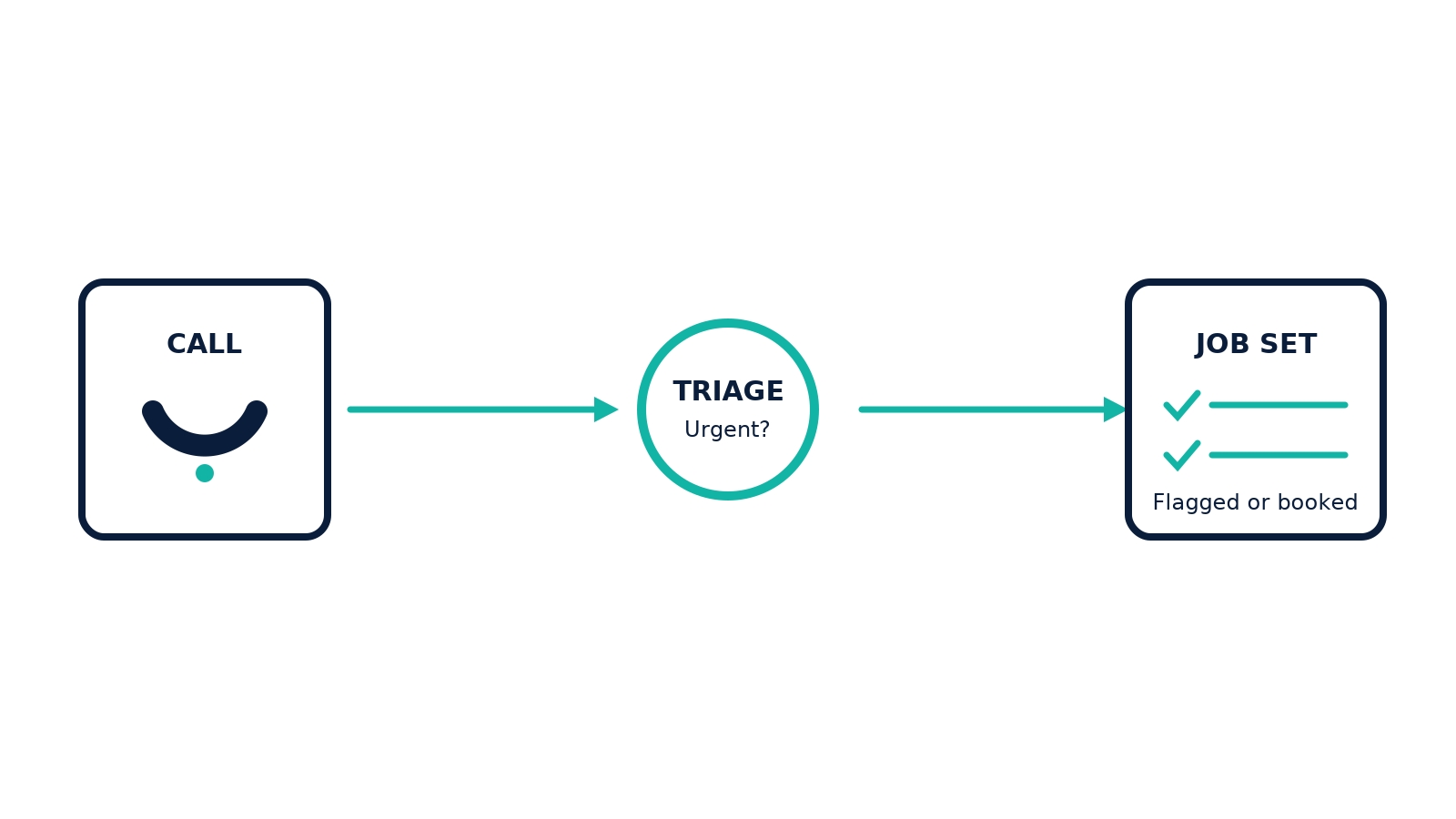
A furnace stops on the coldest night of the year. The homeowner rings your company, gets voicemail, and rings the next contractor on the list.
Meanwhile, a routine maintenance booking sits in the same queue, waiting for someone to call back during office hours. One phone line, two very different jobs, and no one sorting them.
An AI answering service for HVAC companies sorts that queue before a person touches it. It answers every call, separates urgent requests from routine ones, captures the details a dispatcher needs, and books routine work into real calendar slots.
It does not diagnose equipment, it does not decide who goes where, and it does not promise an arrival time. Those decisions stay with your dispatcher and your technicians.
This guide stays specific to HVAC companies. It covers what actually rings, how the two paths should be separated, what an answering service can safely do, where the line to your dispatcher must sit, and what your company has to prepare before the first call is answered.
What actually rings at an HVAC company
HVAC calls are not one queue. They arrive in at least four groups, and treating them as one list is how urgent jobs wait behind routine ones.
- No heat or no cooling. A system that has stopped working, in weather where that matters.
- The caller wants to know they have been heard, what happens next, and when someone will contact them. They do not need a diagnosis over the phone.
- They need a clear next step.
- Safety concerns. A smell of gas, water where it should not be, a strange noise, or a system that has shut itself down.
- These callers need the company's safety procedure, not troubleshooting. If the situation sounds dangerous, the caller should be told to follow that procedure and, where appropriate, to contact emergency services.
- Routine bookings and changes. Annual maintenance, filter changes, a planned replacement quote, or moving an existing visit. These are straightforward, and they are exactly the calls that clog the line when no one separates them from urgent work.
- General questions. Which areas do you cover, do you service this brand, what does a maintenance plan include, how do I prepare for a visit. Short questions that still deserve an answer before the caller tries a competitor.
Two queues, one phone line
The core job of an answering service is separation. Every call gets one of two routes, and the route decides what happens next.
The urgent route is for calls where delay has a real cost: no heat in cold weather, no cooling in extreme heat, a safety concern, a vulnerable person without heating or cooling, or a failure affecting a business or a care setting. These calls are flagged for immediate dispatcher review, with the caller's details, the problem in their own words, and any safety information they gave. Flagging is not dispatch.
The dispatcher still decides who goes, in what order, and what the caller is told about timing. The routine route is for everything else: maintenance, quotes for planned work, rescheduling, and general questions.
These calls can be answered from the company's own information, and routine jobs can be booked into real calendar slots without waiting for the dispatcher. Keeping them out of the urgent queue is what protects the urgent queue.
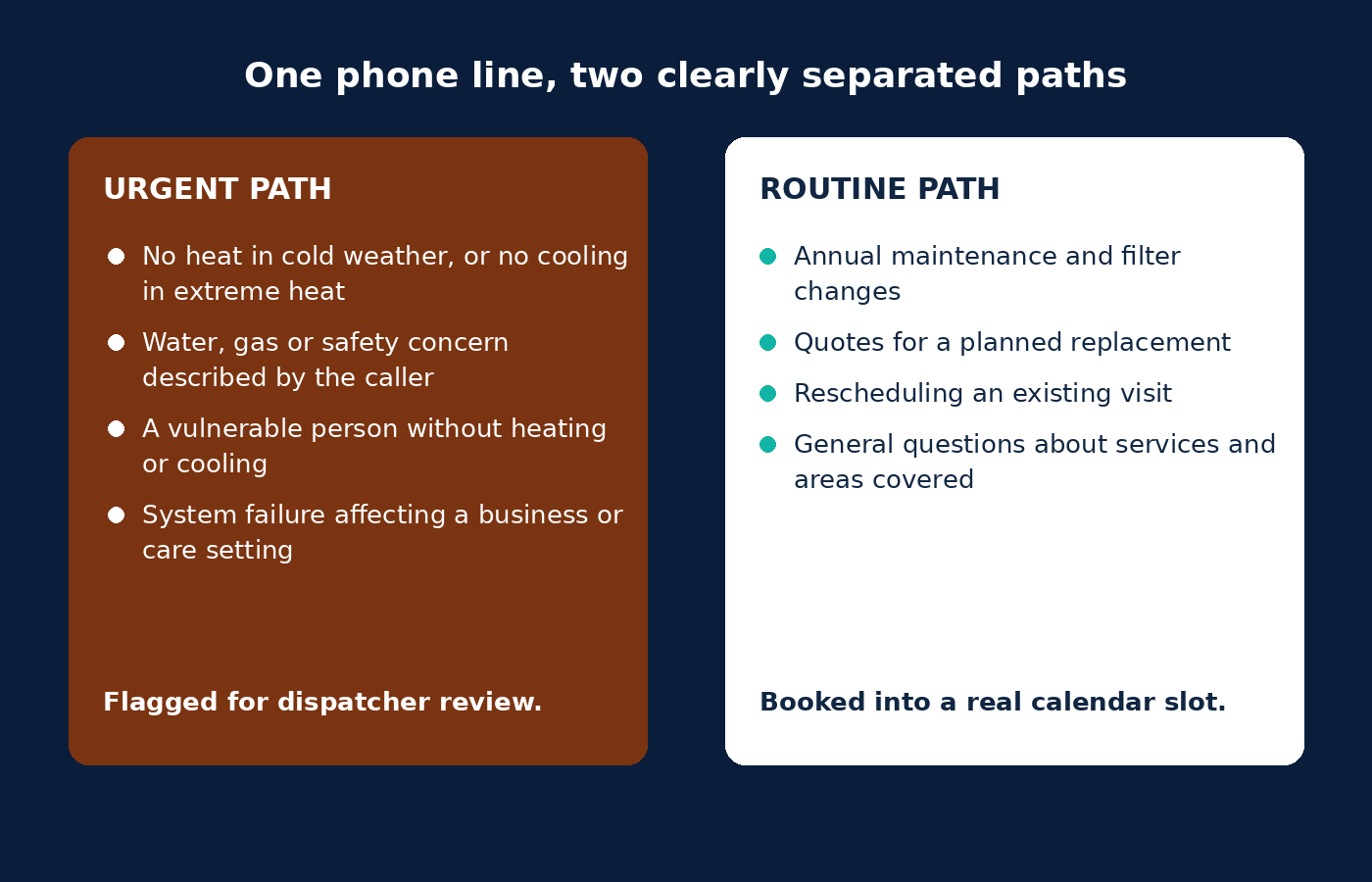
One phone line, two clearly separated paths.
What an AI answering service for HVAC companies can safely do
The safe tasks share a shape. Either the answer already lives in the company's approved information, or the action follows a rule the company set in advance.
- Answer from your own information. Service area, office hours, services offered, maintenance plan details, and preparation steps for a visit. Fixed material, answered the same way every time, never improvised.
- Capture dispatch-ready details. Name and contact details, address and access notes, the system type if the caller knows it, what happened, when it started, and what the caller is asking for.
- Structured notes a dispatcher can read in one minute, instead of a voicemail that has to be replayed twice.
- Separate urgent from routine. Using the company's own escalation rules, not a guess about the equipment. The rules are written by the company, tested before launch, and reviewed whenever a call is misrouted.
- Book routine jobs. Maintenance and other routine visits placed into real calendar slots, using the job types and lengths the company defined, and only into slots the company opened for booking.
- Log everything. A full transcript and a short summary of every call, waiting where the dispatcher starts the day. Nothing depends on a caller remembering to ring back, and nothing depends on one person remembering a message.
Where the line to your dispatcher and technicians must sit
For an HVAC company, the boundary matters more than the feature list. An answering service that sounds confident about equipment it has never seen is a liability, however helpful it sounds.
- No remote diagnosis. It never says what is wrong with a system, what part is needed, or whether a repair is simple.
- Every job is still assessed in person by a technician. The service gathers information and triages urgency.
- It does not assess the equipment.
- No dispatch decisions. It never promises that a technician is on the way, never gives an arrival time, and never orders jobs by priority.
- It flags the urgent case and hands it to the dispatcher, who makes the call with live knowledge of crews, locations and parts.
- No safety judgements. It never tells a caller a situation is safe. Where the company has a safety procedure, it follows that procedure word for word. Where it does not, it escalates to a person at once.
- Uncertainty is escalated, not answered. If the answer is not in the company's approved information, the service says so, takes the caller's details, and promises a follow-up from the team.
- A confident wrong answer about coverage, price or timing does more damage than an honest admission.
Prepare the company before the first call
An answering service is only as safe as the rules behind it. Companies that switch it on and write the escalation rules later end up correcting answers while real customers wait. The preparation is not long, but it cannot be skipped.
- Write the escalation rules first. Which situations count as urgent, which go to same-day review, and which can wait for routine booking. Put names against each route, so a flagged call never sits in a shared inbox with no owner.
- Write the approved answers. Service area, hours, services, maintenance plans, and the exact wording for safety situations. If an answer is not written and approved, the service must not give it.
- Set the calendar rules. Which job types can be booked automatically, how long each takes, how far ahead bookings open, and what happens when a caller cancels. A routine booking that lands in the wrong diary is worse than no booking at all.
- Agree the after-hours cover. Who reviews flagged calls overnight, how they are contacted, and what the caller is told about response times. An urgent flag that no one reads until morning is not cover. It is a longer voicemail.
- Test with hard calls. Before launch, run the service through the calls companies actually get: no heat at midnight, a gas smell, a caller demanding an arrival time, a request for a diagnosis.
- Check that every answer either uses approved material or escalates cleanly. Fix the failures before a real customer finds them.
The dispatch-ready handoff is the real product
The value of an answering service is not that it talked all night. It is what your dispatcher finds in the morning, and during the night. A good handoff has three lists, and each list has an owner.
- Flagged urgent cases. Caller details, problem in their own words, safety information, and the time the call arrived. The dispatcher opens this list first, not last.
- Booked routine jobs. Name, address, job type, and the slot booked, with any access notes attached. The dispatcher can plan routes from this list without re-calling anyone.
- Callbacks. Callers who asked a question the service could not answer, or who need a person before booking. Each callback carries the question and a suggested priority.
Review the handoff for the first two weeks, every day. Read a sample of transcripts, check that urgent flags went to the right person, and note every call that was misrouted. That review is how the escalation rules improve, and how the boundary stays honest.
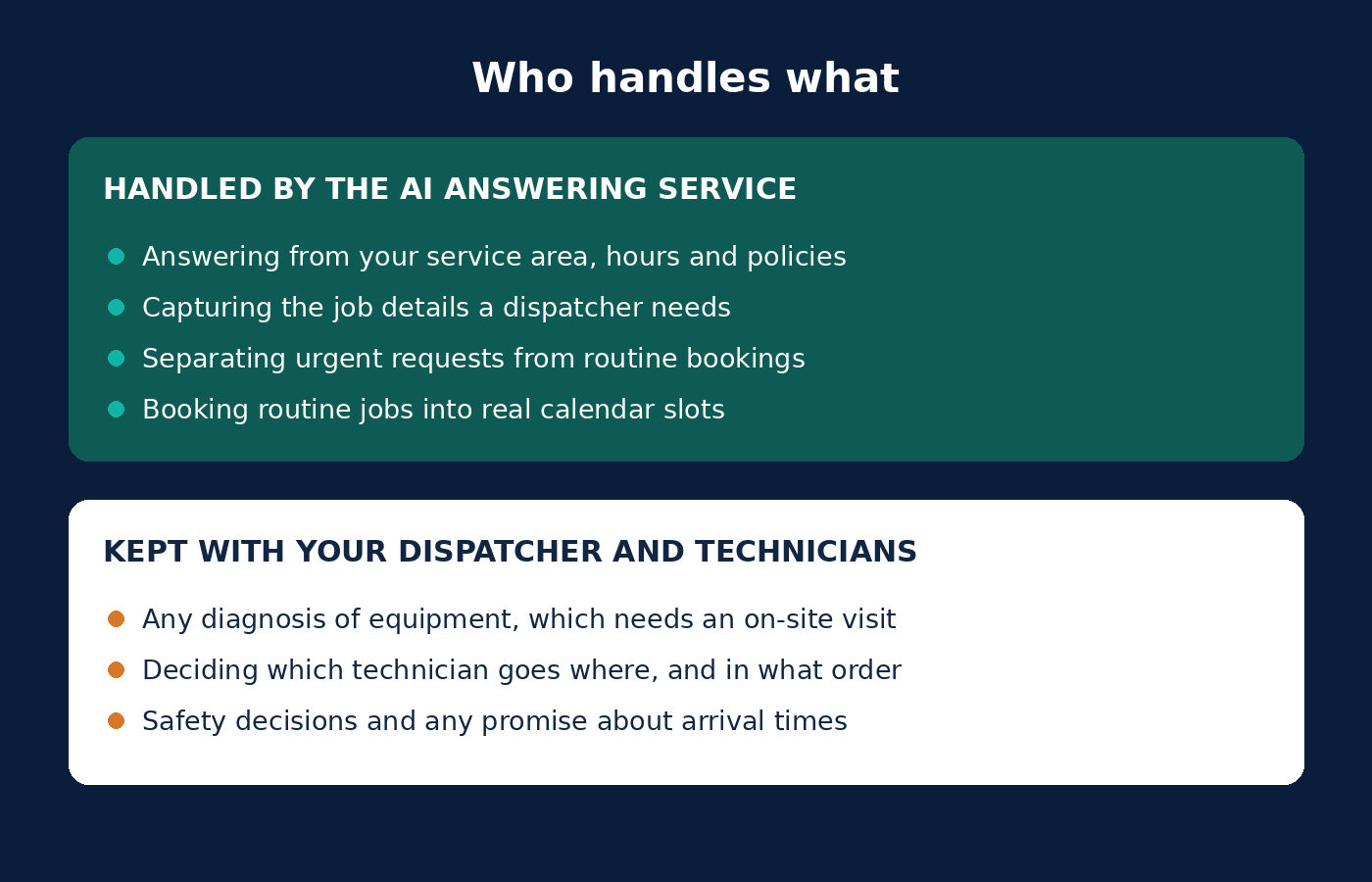
The boundary that matters: preparation by the service, decisions by your team.
How Devxer Pros handles this for HVAC companies
Devxer Pros is Devxer Technologies' product offering for receptionist-style enquiry handling, distinct from DevxerTech custom development. Its HVAC page describes a version built for HVAC service and dispatch, which answers using the company's own service information, triages every request by urgency, and captures a dispatch-ready lead with the details a team needs.
Its own FAQ states plainly that it never diagnoses equipment remotely, and that every job is still assessed in person. You can see that approach on the Devxer Pros page for HVAC companies. For a closer look at how human handoff works in support conversations, see AI chatbots for customer support.
Frequently asked questions
Will an AI answering service diagnose my equipment?
No. It gathers information and separates urgent requests from routine ones. Diagnosis happens on site, by a technician, with the equipment in front of them. Any service that claims otherwise should not be trusted with your customers.
What happens if someone calls with a safety concern?
The service follows the company's safety procedure and escalates to a person at once. It never tells a caller a situation is safe, and it never tries to troubleshoot a safety problem over the phone.
Does it replace the dispatcher?
No. It handles first contact, triage and routine booking, so the dispatcher spends time coordinating technicians instead of answering the same calls and replaying voicemails. Dispatch decisions, job order and arrival promises stay with the dispatcher.
What does the company need to provide for setup?
Escalation rules, approved service information, calendar rules, and the after-hours review routine. The company also needs a named owner for flagged calls and a daily review routine for the first weeks.
Start with the two queues
For an AI answering service for HVAC companies, the phone problem is rarely a lack of effort. It is a single queue carrying two kinds of work, with no one sorting them before they reach a person. Build the separation first: written escalation rules, a short dispatch-ready intake that dispatchers actually want to read, real calendar slots for routine work, and a boundary your team can defend.
If that separation is the gap in your company, talk to DevxerTech about your front desk. Start with one service area, one set of escalation rules, and one month of reviewed handoffs, and let the results decide what expands next. If you are planning a first automation project of any kind, our guide to choosing a first AI automation project covers scope, acceptance criteria and the pilot questions worth agreeing before you build.

