
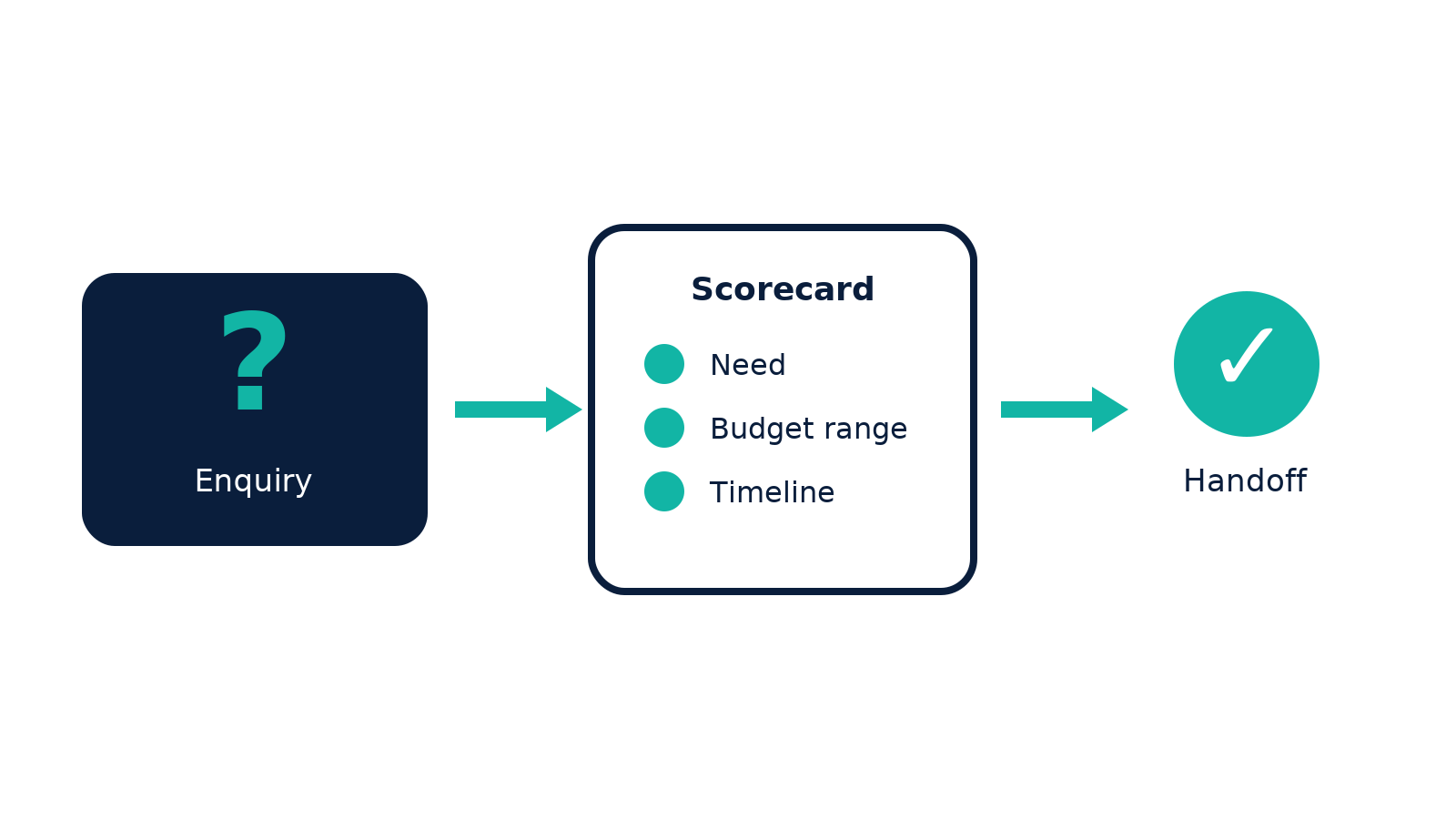
A lead arrives at 9:04 in the morning. By 9:40, a salesperson has spent half an hour on the phone, only to learn the caller wants a service the business does not offer, in a town it does not cover, at a price it cannot meet.
The enquiry was real. The handoff was the problem.
AI lead qualification for service businesses is the short pass that happens before that call. It asks a small set of questions, records the answers in fixed fields, and applies one clear rule: only leads that meet the handoff standard reach a salesperson. Everything else gets a useful next step, not a wasted call.
This guide sets out the questions worth asking, the fields worth recording, and the handoff note your team should expect every time. It is written for owners and sales managers of small service businesses, and it assumes no particular software. Where an AI assistant can run the first pass, that is noted separately, so the process still works when a person asks the questions.
What qualification actually decides
Qualification answers three questions. Is this a real need the business serves?
Can this person buy, or influence the buying decision? Is now the right time for a sales conversation?
If any answer is missing, the handoff is a guess, and guesses cost selling time. It helps to keep three labels apart, because teams often use them as if they meant the same thing.
- Enquiry. Someone has asked about a service. Nothing has been checked yet.
- Qualified lead. An enquiry with a confirmed need, a fit with what the business offers, a way to contact the right person, and an agreed next step.
- Not a fit. An enquiry the business cannot serve well. It still deserves a polite answer, and sometimes a referral, but it should not reach a salesperson as if it were a prospect.
Notice what qualification does not do. It does not close the sale, set the price, or promise a result. Its job is narrower: to make sure the sales conversation starts with facts instead of a cold introduction.
AI lead qualification for service businesses: the five questions that matter most
Five questions cover most service enquiries. Ask them in this order, because each answer makes the next question easier to ask and easier to answer honestly.
1. What do you need, in your own words?
Start open, not with a menu of services. A caller who says they need a deep clean before moving house has told you more than a caller who picked a package name from a list.
Record a short summary in the caller's own terms, then check it against what the business actually offers. A mismatch found here saves every later step.
2. When do you need it done?
Ask for a date or a window, and for what is driving it. A move, a deadline, a broken item, or a seasonal rush each change how urgent the job is and how the team should respond. Vague timing is not a reason to drop the lead, but it is a reason to agree a follow-up date instead of booking a sales call at once.
3. Who decides, and who else is involved?
Ask plainly who will approve the work and whether anyone else needs to agree. This question is often skipped because it feels pushy, yet it prevents the most common waste in service sales: a long conversation with someone who then has to start again with a partner, a landlord, or a manager. Frame it as practical help: knowing who is involved lets the team send the right information once.
4. What budget range have you set aside?
Ask for a range, not an exact figure, and ask it after the need is understood. By then the caller can see why the question matters: it lets the team suggest the right scope instead of quoting blind.
If no budget exists yet, record that honestly. An early stage lead with a real need is still a lead, but it belongs in nurture, not in a salesperson's diary for this week.
5. Where are you, and does the job fit how we work?
Confirm location, access, and any condition that changes the job, such as size, timing restrictions, or equipment the business does not carry. Fit questions protect both sides. A business that takes work outside its area or ability usually pays for it later, in travel time, rework, or a disappointed customer.
Five questions are enough for a first pass. A longer form feels like an interrogation, and callers stop answering honestly. Anything the sales conversation still needs can be asked there, by someone who already knows the basics.
Turn the answers into a scorecard
Questions only help if every enquiry is judged the same way. A scorecard fixes the fields, so one person's strong lead is not another person's guess.
For each field, record one of three ratings: confirmed, partial, or unknown. Unknown is a valid answer. It means the question was not answered yet, not that the lead is bad.
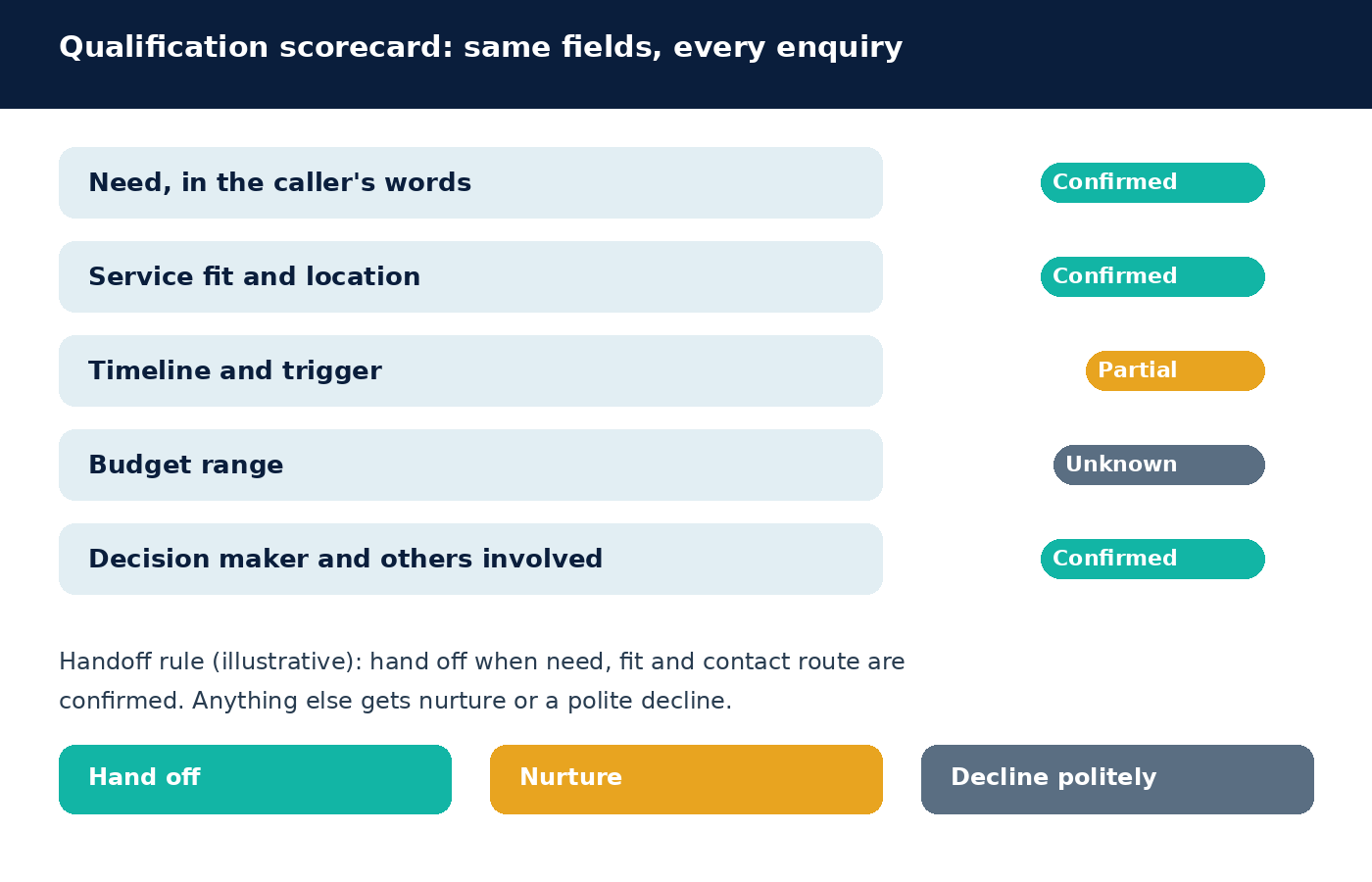
Then agree a handoff rule in advance, and write it down. The following rule is illustrative, and each business should set its own version: hand off when need, fit, and a contact route are confirmed, and at least one of timeline or budget range is present. Leads that miss the rule are not rejected.
They are nurtured with a follow-up date, or declined politely with a clear reason. The fields on the scorecard are the same fields that belong in the handoff note:
- Contact name and best contact route. Include the time the person is reachable, not just a number.
- Need in the caller's words. One or two sentences, not a product label.
- Service area and location. So the salesperson never has to recheck coverage.
- Timeline and trigger. The date or window, and what is driving it.
- Budget range. A range, or a clear note that none exists yet.
- Decision maker and others involved. Names or roles, plus what each person needs to decide.
- Next step agreed. A call time, a visit, or a follow-up date the caller actually accepted.
What a good handoff note contains
A salesperson should be able to read the handoff note in under a minute and start the call without repeating a single question. The following note is illustrative, and it shows the standard to aim for. Illustrative handoff note: caller wants a full house clean before a move in two weeks, within the service area, budget range shared, caller is the decision maker, callback agreed for Tuesday morning.
If the note cannot support that kind of opening, the lead was not ready to hand off. Send it back for one more question, not forward with an apology attached. Teams that accept thin notes soon stop trusting the process, and qualification quietly dies.
What not to ask, and what not to assume
Good qualification is as much about restraint as coverage. A few habits cause most of the damage.
- Do not ask for an exact budget before understanding the need. It reads as a filter, and callers answer defensively or leave.
- Do not assume the caller is the decision maker. Ask, and record who else matters.
- Do not treat urgency as fit. An urgent job outside the service area is still outside the service area.
- Do not promise price, dates, or outcomes during qualification. Qualification gathers facts. Commitments belong with the person who will deliver the work.
- Do not collect information the team does not need. Payment details, passwords, and sensitive personal data have no place in a first enquiry.
Qualification is also not a sales pitch in disguise. If the first questions exist only to steer the caller toward a package, callers notice, and the answers get less honest. Ask to understand, record what you learn, and let the sales conversation do the selling.
Where an AI assistant fits, and where it does not
An AI assistant can run the first pass well: it asks the same five questions every time, records answers in fixed fields, applies the handoff rule, and routes the result to the right place. It never gets tired at the end of a long day, and it never forgets to ask the budget question. That consistency is the real benefit.
It is not cleverness, it is coverage. There are clear limits. A caller who is upset, confused, or describing something unusual should reach a person quickly, with the conversation so far attached.
A complex job, a vulnerable caller, or a request the assistant does not recognise should also escalate, not be squeezed into a scorecard. The handoff rule should include an escape route: when in doubt, a person takes over.
For a receptionist-focused solution, explore Devxer Pros for website chat, voice inquiries and appointment workflows. Devxer Pros is Devxer Technologies' configured receptionist product, so this is a company offering, not an independent endorsement.
If qualification needs to connect with a CRM, a calendar, or a booking system, talk to DevxerTech about your front desk. A custom workflow can carry the same five questions and the same handoff rule, while fitting the tools the team already uses.
Frequently asked questions
How many questions should qualification ask?
Five to seven for a first pass. Fewer leaves the salesperson guessing, more turns the enquiry into an interview. If a question never changes the handoff decision, remove it.
Should every lead be scored?
Score only what changes the decision. Need, fit, timeline, budget range, and decision maker change it. Extra scores look thorough and add nothing except work.
What happens to leads that do not qualify?
They get a clear next step, not silence. That may be a follow-up date, useful information, or a referral to a business that can help. A polite decline protects the business reputation far better than an unanswered enquiry.
Does AI qualification replace the sales call?
No. It prepares the call. The salesperson still builds trust, confirms scope, and agrees terms. Qualification simply makes sure that conversation happens with the right person, about a real need, at a sensible time.
A starting checklist for this week
Start with one service, not the whole business. Prove the process where the volume is highest, then extend it.
- Agree the five questions and the exact fields for each. Write them where everyone who takes enquiries can see them.
- Agree the handoff rule. State which ratings must be confirmed before a lead reaches sales.
- Write one handoff note template. Use it for every lead, without exception, for the first month.
- Review the first twenty handoffs. Ask sales which notes helped and which questions were missing, then adjust one thing at a time.
If you are planning a first automation project of any kind, our guide to choosing a first AI automation project covers scope, acceptance criteria and the pilot questions worth agreeing before you build. AI lead qualification for service businesses is a small discipline with an outsized effect. Ask five good questions, record the answers the same way every time, and hand off only what meets the rule. The sales team gets fewer calls and better ones, and callers get a faster answer from someone who already understands their situation.

