
A prospective client finds your firm at ten at night. She has a deadline in three weeks, a question about which documents she needs, and a worry she cannot quite put into words.
Your office opens at nine in the morning. By then she has messaged two other firms, and the one that answered first has her consultation booked.
An AI receptionist for immigration consultants does not solve that problem by giving advice faster. It solves it by handling the first contact properly: answering general questions from your firm's own information, capturing the details a consultant needs, and booking a consultation with the right person.
Advice, eligibility and strategy stay with your licensed team, exactly where they belong. This guide stays specific to immigration firms: what first enquiries actually look like, which parts a receptionist can safely handle, where the legal advice line must sit, and what your firm has to prepare before the first enquiry is answered.
What actually arrives at an immigration firm
First enquiries at an immigration firm are rarely simple. Most visitors arrive with a mix of a practical question and a personal worry, and the receptionist has to separate the two without pretending to resolve the worry.
- Pathway questions. What is the difference between two routes, what does each one usually require, and how long does each stage usually take. These are general information questions, and they are answerable only from material the firm has approved.
- Deadline pressure. A permit that expires soon, a document that is still missing, or a decision letter the visitor does not fully understand.
- The receptionist must capture the date and the document, not interpret what the deadline means for that person.
- Document confusion. Which documents are needed, in what form, and whether a translation or a certified copy is required. Again, the answer is the firm's published checklist, not a judgement about this visitor's file.
- Consultation requests. A visitor who has already decided they want professional help and simply wants a time, a price range for a consultation, and a named contact.
- These are the easiest enquiries to lose to a slow reply, because the visitor is ready to book.
- Sensitive disclosures. A visitor may share health, family or employment details in the first message.
- The receptionist should acknowledge the message, take only the details needed for intake, and explain that a consultant will review the case in confidence. It should never repeat sensitive details back unnecessarily or store them in an open channel.
What an AI receptionist for immigration consultants can safely handle
The safe tasks share a shape. Either the answer already lives in the firm's approved information, or the action follows a rule the firm set in advance.
- Answer from your own information. Services you offer, the consultation process, general pathway information you have published, office hours, languages spoken, and how to prepare for a consultation.
- Fixed material, answered the same way every time, never improvised.
- Capture the details consultants need. Name and contact details, current status in the visitor's own words, pathway interest, key dates, documents already held, and what the visitor is asking for.
- Structured notes a consultant can read in two minutes, instead of a long chat transcript with no summary.
- Book real consultations. Slots from the firm's actual calendar, matched to the consultant who handles that pathway, with the intake notes attached.
- A booking is only a booking when it lands in a real diary, in the right time zone, with a confirmation the visitor can keep.
- Route by readiness, not by outcome. A case with documents ready and a clear next step can go to a standard consultation.
- A case with a near deadline, a refusal, or missing core documents can be flagged for earlier review. Grouping is not a decision.
- It is a way of making sure the consultant sees the urgent file first.
- Log everything. A full transcript and a short summary of every conversation, waiting where the team starts its day. Nothing depends on a visitor remembering to call back, and nothing depends on one staff member remembering a phone message.
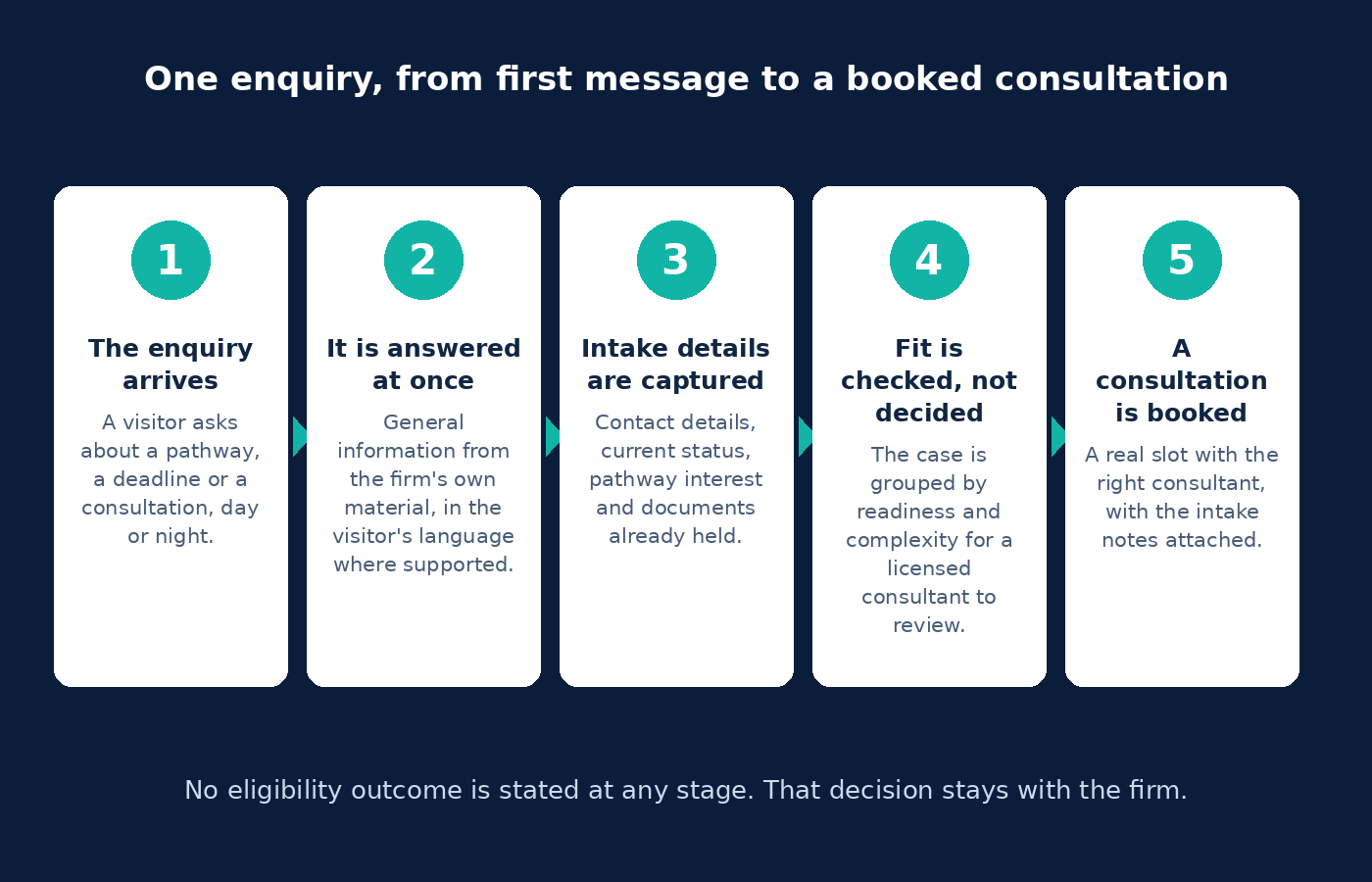
One enquiry, from first message to a booked consultation.
Where the legal advice line must sit
For an immigration firm, the boundary matters more than the feature list. A receptionist that books beautifully but strays into advice is a liability, however natural it sounds. Who is allowed to give immigration advice depends on the country and the regulator involved, so the firm, not the software, sets that boundary in writing.
- No eligibility statements. It never says a visitor qualifies, is likely to succeed, or should choose one pathway over another.
- It can explain what a pathway generally involves, using the firm's approved material, and then hand the personal question to a consultant.
- No strategy. It never recommends a sequence of applications, a timing choice, or a way around a refusal. Those are professional judgements, and they belong in a consultation, with the full file in front of the consultant.
- No fee advice for a specific case. It may explain how consultations are priced in general, where the firm publishes that information.
- It must not quote a fee for a visitor's case, promise a result for a price, or suggest that paying more changes an outcome.
- Uncertainty is escalated, not answered. If the answer is not in the firm's approved information, the receptionist says so, takes the visitor's details, and promises a follow-up from the team.
- A confident wrong answer about a document or a deadline does more damage than an honest admission.
- Sensitive cases get a human quickly. Refusals, appeals, detention, removal, and any case where the visitor describes harm or urgency should be flagged for prompt human review, with a clear explanation of what happens next.
- The receptionist does not triage legal risk. It makes sure a person sees the case soon.
Prepare the firm before the first enquiry
A receptionist is only as safe as the material behind it. Firms that rush to switch it on, and write the rules later, end up correcting answers in public. The preparation is not long, but it cannot be skipped.
- Write the approved answers first. General pathway pages, the consultation process, document checklists, office hours, languages, and the exact wording for the boundary sentences.
- If an answer is not written and approved, the receptionist must not give it.
- Define the escalation list. Which topics go straight to a consultant, which go to a same-day callback, and which can wait for the morning list. Put names against each route, so a flagged case never sits in a shared inbox with no owner.
- Set the calendar rules. Which consultants take which pathways, how long each consultation type lasts, how far ahead bookings open, and what happens when a visitor cancels. A booking that lands in the wrong diary is worse than no booking at all.
- Decide what is never collected. Some details have no place in a first contact form or chat. Agree the intake fields in advance, keep them to what a consultant needs for a first consultation, and explain to visitors why each field is asked for.
- Test with hard questions. Before launch, run the receptionist through the questions visitors actually ask: a near deadline, a refusal, a request for a guarantee, a question about chances.
- Check that every answer either uses approved material or escalates cleanly. Fix the failures before a real visitor finds them.
The morning handoff is the real product
The value of a receptionist is not that it talked all night. It is what your team finds in the morning. A good handoff has three lists, and each list has an owner.
- Booked consultations. Name, contact, pathway interest, documents held, and the consultant assigned. The consultant opens the consultation with context, instead of spending the first ten minutes re-asking the intake questions.
- Callbacks. Visitors who asked a question the receptionist could not answer, or who need a consultant before booking. Each callback carries the question, the deadline if there is one, and a suggested priority.
- Flagged cases. Sensitive or urgent cases, with a short note on why they were flagged and who has been notified. Nothing in this list should wait for a weekly review.
Review the handoff for the first two weeks, every day. Read a sample of transcripts, check that bookings landed in the right diaries, and note every question that had to be escalated. That review is how the approved answers improve, and how the boundary stays honest.
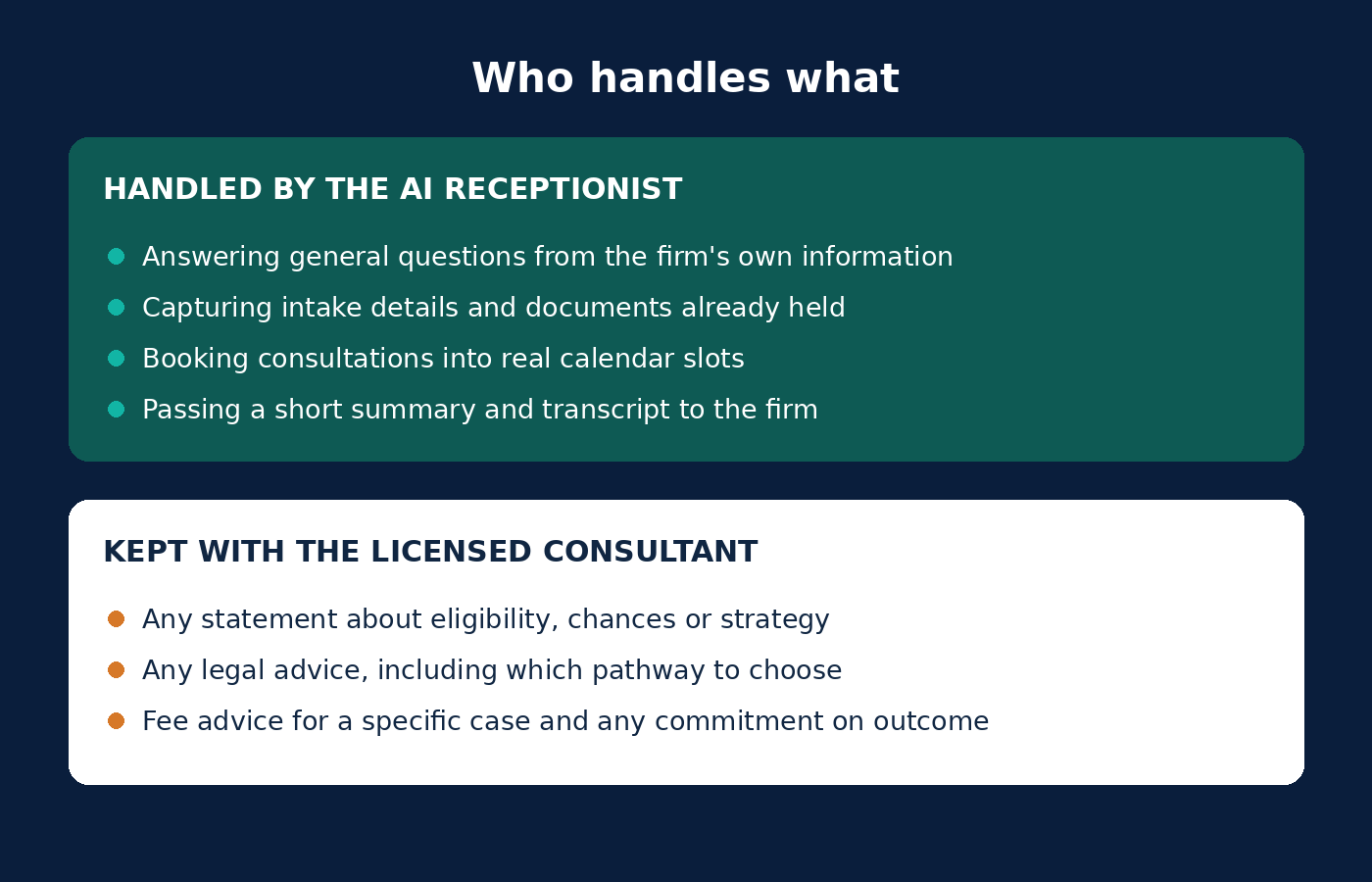
The boundary that matters: preparation by the receptionist, decisions by the consultant.
How Devxer Pros handles this for immigration firms
Devxer Pros is Devxer Technologies' product offering for receptionist-style enquiry handling, distinct from DevxerTech custom development. Its immigration page describes a version built for Canadian RCIC firms, which answers from the firm's own knowledge base, qualifies visitors against the firm's criteria, and books consultations directly into the consultant's calendar.
Its own FAQ states plainly that it gathers information and qualifies fit, and never states eligibility outcomes, quotes fees, or gives legal opinions. You can see that approach on the Devxer Pros page for immigration firms, and watch the demo video to see a live call handled the same way.
The demo uses a fictional practice, and it shows the receptionist greeting a caller, staying clear of advice, answering a fee question honestly, capturing the caller's details and pathway, and booking a 30-minute consultation. For a closer look at how human handoff works in support conversations, see AI chatbots for customer support.
Frequently asked questions
Will an AI receptionist give visitors immigration advice?
No, if it is set up correctly. It answers general questions from the firm's approved information, captures intake details, and books consultations. Any question about a visitor's own eligibility, strategy or chances goes to a licensed consultant.
What happens when a visitor asks about their chances?
The receptionist should not estimate chances or recommend a pathway. It should explain that outcomes depend on the full file, take the visitor's details, and book or arrange a consultation where a consultant can review the case properly.
Does it replace consultation coordinators?
No. It handles first contact, intake and booking, so coordinators spend their time on consultations, follow-up and case preparation instead of answering the same general questions and chasing missed messages.
What does the firm need to provide for setup?
Approved general information and document checklists, the escalation list, calendar rules, and the exact wording for boundary sentences. The firm also needs a named owner for flagged cases and a daily review routine for the first weeks.
Start with intake, not advice
For an AI receptionist for immigration consultants, the first contact problem is rarely a lack of information. It is a lack of a safe, fast route from a first question to a booked consultation, without advice leaking into the gap. Build that route first: approved answers, a short intake form that consultants actually want to read, real calendar slots, and a boundary your team can defend.
If that route is the gap in your firm, talk to DevxerTech about your intake. Start with one pathway, one consultation type, and one month of reviewed handoffs, and let the results decide what expands next. If you are planning a first automation project of any kind, our guide to choosing a first AI automation project covers scope, acceptance criteria and the pilot questions worth agreeing before you build.

