
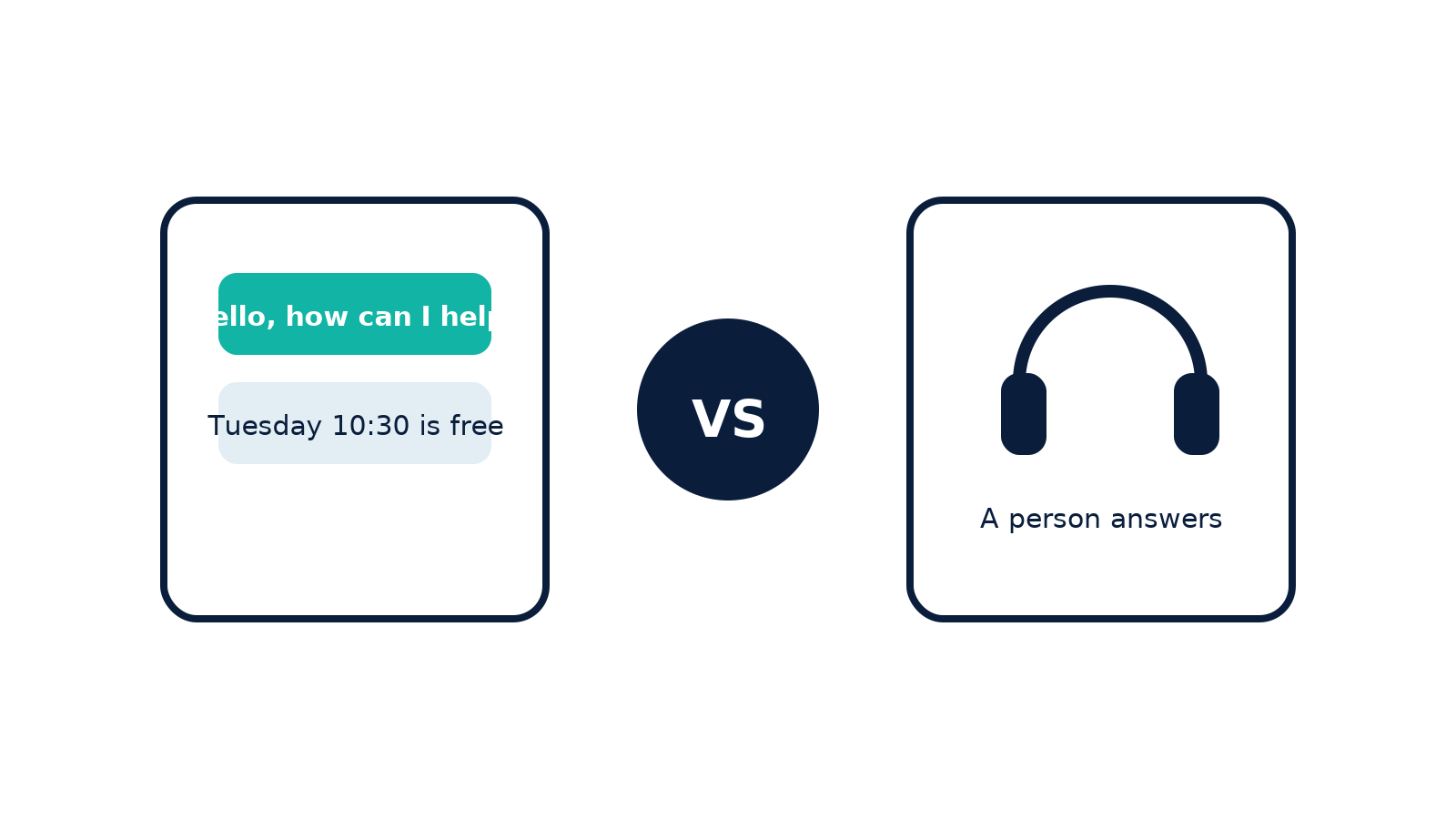
Two businesses miss the same kind of call and solve it in opposite ways. One hires a human answering service, and every caller speaks to a person who takes a careful message.
The other sets up an AI receptionist, and callers get answers and confirmed bookings at once. Both owners feel they chose well, and both are right, because they had different calls to handle.
This AI receptionist vs answering service comparison is written for small business owners comparing enquiry-handling options. It compares an AI receptionist with a human answering service on scope, coverage, handoff, caller experience, and cost, so the decision follows the business, not the sales pitch. The direct answer is simple: decide by your call mix.
Routine calls that end in a booking suit an AI receptionist. Calls that need judgement on every conversation suit people. Most businesses sit between the two, which is why the hybrid option at the end of this guide matters.
One caution before the detail: provider details vary widely inside each category. Treat everything below as typical patterns to verify against a written quote, not as a promise about any specific provider. Where this guide names a price, it names the source too.
AI receptionist vs answering service: first, name what each option actually does
Labels hide the real difference, so start with plain definitions. AI receptionist. Software that answers calls and website chats, asks configured questions, and follows configured booking and escalation rules.
It works from the business information it was set up with, such as services, hours, and booking logic, and it can handle several conversations at once. Answering service. A team of human agents, usually shared across many businesses, who answer the phone to a script, take messages, and pass them to the business.
The agent is a person, but the agent is not a member of your team and does not book from your calendar unless that service is specifically arranged. In-house receptionist. Your own employee at your own desk.
This guide does not compare that option in depth, because its cost and management are a different decision, but keep it in mind: anything a service cannot do, an employee on site usually can, at a much higher total cost. Notice the asymmetry that drives the whole comparison. An AI receptionist finishes routine work on the call.
An answering service usually starts work for your team after the call, in the form of a message and a callback. Neither is wrong. They simply complete different amounts of the job.
Scope: what gets finished on the call
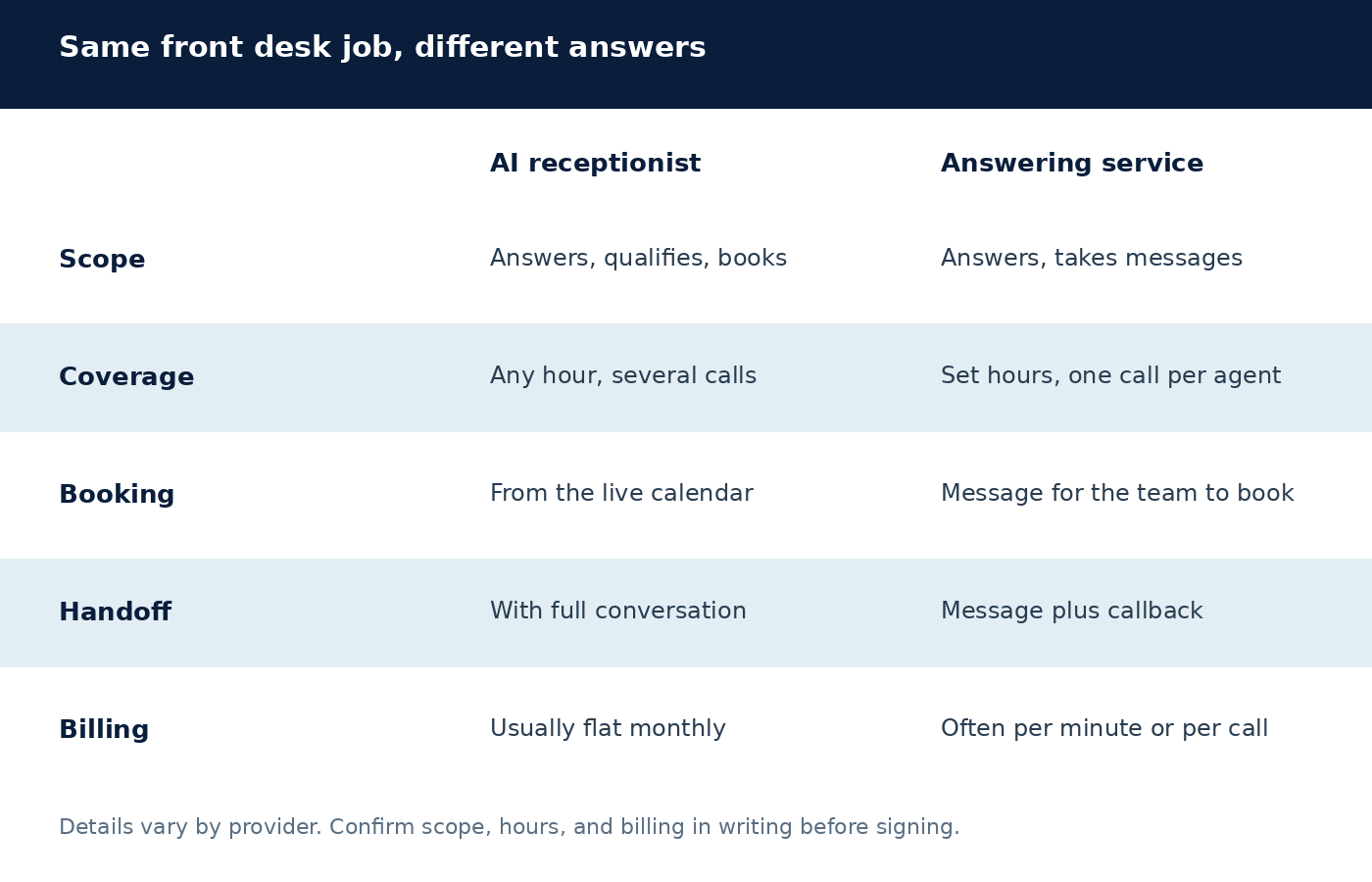
Scope is the first dimension to compare, because it decides how much follow-up work each call creates.
- Answers questions. Both options answer, but from different sources.
- An AI receptionist answers from configured business information. An answering service agent answers from a script and general instructions, and will usually pass detailed questions to your team rather than answer them.
- Qualifies the enquiry. An AI receptionist can ask a fixed set of questions and record the answers in fixed fields. An agent can do the same, but the fields and the follow-up depend on the script and the individual agent.
- Books the appointment. This is the sharpest scope difference.
- An AI receptionist connected to the calendar can confirm a booking on the call. A standard answering service takes the booking request as a message, and your team still has to confirm it, which reintroduces the delay the service was meant to remove.
- Takes orders or payments. Some providers in both categories support simple transactions, and many do not. Do not assume either option handles payments. Ask, and test it, before promising it to customers.
Write down the five most common calls your business receives, and mark which ones each option would finish on the call. If most of them end in a booking, scope alone points one way. If most need a person to decide, it points the other way.
Coverage: hours, peaks, and simultaneous calls
Coverage has three parts, and providers often advertise only the flattering one. Hours are the first part: an AI receptionist can answer at any hour without shifts, holidays, or sick days.
An answering service covers the hours in the contract, and round the clock cover usually costs more, because people work those hours. Ask for the exact covered hours in writing, including weekends and public holidays.
Peaks are the second part. Calls arrive in bursts: a morning rush, an advertisement going out, a storm that breaks boilers.
An AI receptionist handles several calls at once, so a burst does not become a queue. An answering service has a fixed number of agents on shift, so a burst becomes hold music and, eventually, voicemail.
If your business has sharp peaks, ask how many simultaneous calls are covered, not just whether the phone gets answered. Channels are the third part. Many AI receptionists handle website chat and voice in one system.
Answering services are usually phone only. If a large share of your enquiries arrive through the website, a phone only service leaves that half of the front desk uncovered.
Handoff: what your team receives
Handoff quality decides whether the morning starts with work or with detective work. A good handoff from an AI receptionist includes the whole conversation, the answers given, the booking if one was made, and the reason for escalation.
Staff open a complete record, not a mystery. A standard answering service handoff is a message: a name, a number, a short note, and a callback request. That message is honest and often enough, but it leaves the team to redo the conversation.
Every callback is a second conversation, and some customers will not answer it. When comparing providers, count the callbacks each option creates, not just the calls it answers.
Escalation rules matter for both options. Agree in advance which calls go straight to a person: urgent requests, complaints, sensitive personal circumstances, and anything the system or script cannot classify.
An escalation that arrives with context is helpful. An escalation that arrives as a bare name is a chore.
Caller experience: speed versus judgement
Callers judge the experience by two things: how fast they got help, and whether the help was right. AI receptionists win on speed for routine calls.
There is no queue, no callback, and the answer or booking arrives in the same conversation. For a caller who wants a time, a price range, or opening hours, speed is the experience.
People win on judgement. An upset customer, an unusual problem, a request that does not fit the standard menu, or a situation with real consequences all benefit from a human who can listen, adapt, and take responsibility.
An AI receptionist that tries to handle those calls without escalating will frustrate the caller more than a queue would have. Language deserves a specific question. Some AI receptionists support several languages as a configured feature, and some answering services staff particular languages on particular shifts.
Do not accept a general claim about languages. Test the languages your customers actually use, with real test calls, before signing.
The honest summary is that neither option gives every caller the best experience. The right question is which kind of caller your business gets most, and what happens to the rest under each option.
Cost: compare the bill, not the headline
Cost comparisons go wrong when a monthly fee is compared with a per minute rate as if they were the same thing. They are different billing shapes, and the shape decides what a busy month costs.
- Flat monthly plans. Common for AI receptionists.
- The business pays a set fee for a plan with stated limits, such as included chat volume or voice minutes. The risk is overage charges or throttling above the limit, so read the limit and the overage term, not just the headline fee.
- Per minute or per call billing. Common for answering services.
- The bill follows call volume and call length. A quiet month is cheap and a busy month is expensive, and long, careful calls cost more than short ones.
- Ask for the minimum charge, the rounding rule, and what counts as billable time.
- Setup and tuning. Ask what setup includes, who writes the scripts or configures the questions, and what changes cost later. A cheap plan with expensive change requests is not a cheap plan.
As a verified example, Devxer Pros publishes its own comparison on its homepage. It lists a live answering service at 300 to 1,000 dollars per month and a full-time receptionist at 4,000 dollars or more per month.
Its own Front Desk plan is from 349 dollars per month and Front Desk Plus from 599 dollars per month, with a 14 day pilot at no cost and no card required. Those are Devxer Pros' own figures, checked on its homepage for this guide, not independent market research.
Use them as one worked example of how providers frame the comparison, and get written quotes from any answering service you consider, because per minute billing makes generic price claims unreliable. A practical cost test is to price three months, not one: a quiet month, a normal month, and your busiest month, using each provider's actual billing rules. The cheapest option in a quiet month is often the most expensive in a busy one.
The hybrid option
Many businesses do not need to choose one option for every call. A hybrid setup lets an AI receptionist answer first, finish routine calls, and hand complex, urgent, or sensitive calls to a person with full context.
The AI covers hours and peaks, and people cover judgement. Hybrid only works when the handoff is designed, not assumed. Set the escalation triggers in advance, test them with difficult calls, and make sure the person receiving the handoff sees the conversation, not just a name.
A hybrid with a poor handoff is worse than either option alone, because the caller has already explained once and must explain again. Consider hybrid when routine calls dominate but a meaningful minority need judgement, when peaks are sharp, or when after-hours cover matters but the business cannot justify a person on every call. It is the most common sensible answer, and the least advertised, because it does not fit a simple sales story.
Decision framework: five questions
Answer these five questions with real numbers from your own call history where you have them. The pattern of answers usually decides the option without further debate.
1. What share of calls end in a booking? Above half, booking on the call matters most. Below a quarter, message quality matters more.
2. When do calls arrive? Evenings, weekends, and sharp peaks favour always-on cover. Pure business hours favour a staffed service.
3. What share need judgement? Urgent, emotional, or unusual calls need people. Count them honestly, including the ones that start routine and turn difficult.
4. How fast must the answer be? If a slow callback loses the customer, same-call completion matters. If customers happily wait for a callback, message quality is enough.
5. What does a busy month cost under each billing shape? Price the quiet, normal, and busy month for each provider, including overages and change fees.
If the answers pull in both directions, that is a signal for hybrid, not a sign that the framework failed. Split the calls by type and assign each type to the option that handles it best.
Questions to ask any provider
Take this list to every sales conversation, for either option, and keep the written answers for comparison:
- Exact covered hours. Including weekends, holidays, and peak simultaneous calls.
- What finishes on the call. Answers, qualification, booking, and any transaction, each confirmed separately.
- Handoff contents. Exactly what your team receives, and how fast it arrives.
- Escalation triggers. Which calls go to a person, and how the person sees the conversation.
- Billing in full. Base fee, limits, overage rates, minimums, rounding, and change fees.
- Languages tested. Proven by test calls in the languages your customers use.
- Exit terms. Contract length, notice period, and who owns the scripts, recordings, and conversation history.
For a receptionist-focused configured product, explore Devxer Pros, Devxer Technologies' product offering for website chat, voice inquiries and appointment workflows. Compare its published plans and pilot terms against the questions above, and against written quotes from any answering service, before deciding.
If booking on the call is the deciding factor, read our guide to AI appointment booking assistants, which explains availability checks, written confirmation, and the exception cases a booking system must handle. For the wider coverage question, see our guide to after-hours call answering.
Frequently asked questions
Can an answering service book appointments?
Some can, as a specifically arranged service, but a standard message-taking service cannot confirm a booking from your live calendar. If booking matters, ask for that capability by name and test it, rather than assuming it from the word answering.
Does an AI receptionist replace my staff?
No. It replaces the routine first conversation, not the judgement, the service delivery, or the relationship.
Staff still handle escalations, complex cases, and the work itself. The gain is fewer callbacks and fewer missed routine calls, not an empty office.
Which option handles angry or upset callers better?
People do, in general. An AI receptionist should recognise distress, complaints, and urgency and hand over promptly with context, not attempt to calm or resolve the situation itself. Test escalation with a genuinely difficult test call before launch.
What about calls in more than one language?
Both options can support several languages, but only as a configured or staffed feature. Verify with test calls in each language your customers use, and check which languages are covered at night and at weekends, not just during the day.
Can I start with one option and change later?
Yes, and a short pilot is the sensible way to do it. Check the exit terms before signing: contract length, notice period, and ownership of scripts and conversation history. A provider that is hard to leave is a risk, whatever its monthly fee.
A practical takeaway
In an AI receptionist vs answering service comparison, an AI receptionist finishes routine calls, including bookings, at any hour and at any volume. An answering service gives every caller a person, and gives your team a message and a callback.
Choose by your call mix: booking-heavy and peaky points to an AI receptionist, judgement-heavy points to people, and a mix points to a hybrid with a designed handoff. Price the busy month, test the difficult calls, and get every promise in writing.
If you want a custom build rather than a configured product, talk to DevxerTech about AI services. For customer conversations and lead qualification, see our chatbot development service.
Start with the five decision questions and the provider checklist in this guide. The right front desk is the one whose handoff your team actually trusts on a busy Monday morning.

