
It is 8:40 on a Tuesday evening. A homeowner with a leaking pipe searches for a plumber, finds a business with good reviews, and calls.
Nobody answers. The caller tries one more number, reaches a person, and books.
The first business never learns the call happened. Its phone simply stopped working as a sales tool at closing time.
After-hours call answering for small business is the plan that stops that loss. It covers the hours when the team is away, sorts each enquiry by what it needs, and hands staff a reviewed list in the morning.
This guide builds that plan for a general small business: evenings, nights, weekends, and holidays, with a named owner for every handoff. Industry-specific detail lives in the related guides linked at the end.
Start from one uncomfortable fact. Your business closes. Customer problems do not follow your opening hours, and callers rarely leave a second message. A coverage plan is therefore not a luxury add-on. It is part of answering the phone properly.
Map the hours you actually miss
Before choosing any tool, find out where the gaps are. Look at the last few weeks of missed calls, voicemail messages, and web enquiries that arrived outside opening hours.
Sort them by time of day and day of the week. Most small businesses find the same pattern: a busy evening shoulder just after closing, a quiet night with a few genuinely urgent calls, and a weekend pile that waits until Monday.
Also map the hours that are not strictly after hours but behave like them: lunch breaks, days when the whole team is on site, and public holidays. A plan that covers only evenings will still leak enquiries at midday. Write down every block where nobody is reliably available to answer, including the ones the team prefers not to think about.
This audit needs no special software. A phone log, a voicemail inbox, and a shared note are enough. The point is not precision. It is honesty about which hours are truly uncovered.
Decide what each hour needs
Not every after-hours call needs the same response. Sorting enquiries into four kinds keeps the plan simple and stops urgent calls from waiting behind routine ones.
- Urgent. A problem that cannot wait until morning, such as a leak, a lockout, or a safety concern. These calls need a live route to a named on-call person, not a message.
- Bookable. A routine request with a clear next step, such as an appointment, a quote visit, or a service booking. These can be captured fully and booked into a real slot.
- Informational. A question about hours, services, prices, or location. These can be answered from the business's own information, with a follow-up offered where the answer is not certain.
- Not for us. Wrong numbers, sales calls, and requests the business cannot serve. These still deserve a polite close, but they should never reach the morning list as if they were leads.
The business must define urgent for itself, in writing, before launch. What counts as urgent for a plumber differs from what counts as urgent for a consultancy, and an answering service cannot guess. A short list of urgent triggers, agreed by the owner, is the single most useful page in the whole plan.
A coverage timeline with named owners
A plan is only real when every block has an owner. Ownership means one named person or role who checks the result and acts on it, not a shared inbox that everyone assumes someone else is watching.
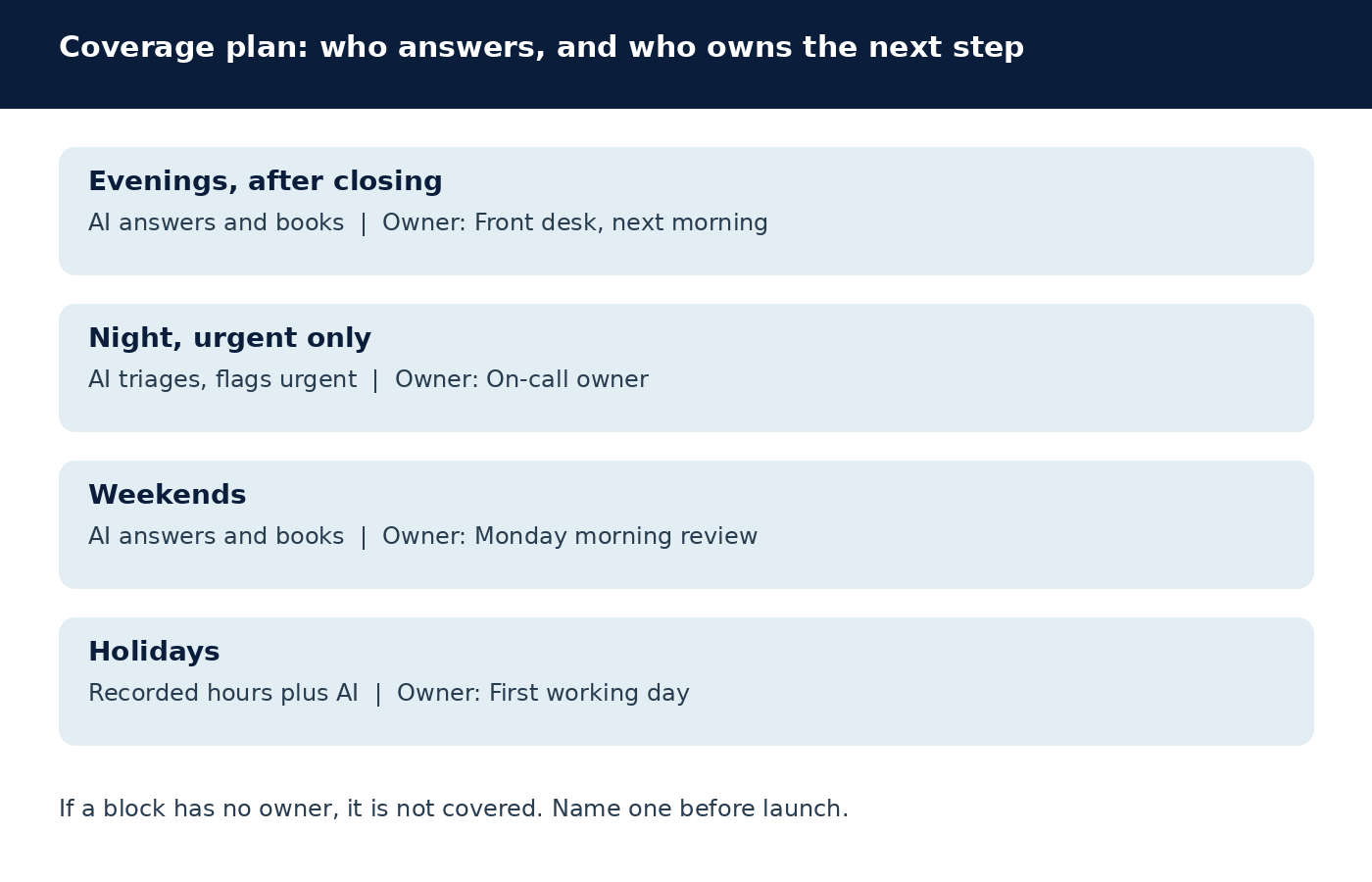
Every hour covered, every handoff owned.
- Evenings, after closing. Answer every call, book routine requests, and flag anything urgent. Owner: the front desk, first thing next morning.
- Night. Triage only. Routine requests are captured for the morning, urgent triggers reach the on-call owner at once. Owner: the named on-call person for that night.
- Weekends. Answer and book as in the evening, with a Monday morning review of everything captured. Owner: whoever opens on Monday, by name.
- Holidays and closures. State the closure clearly, answer within the agreed rules, and set the return date for follow-up. Owner: the first working day's duty holder.
If a block has no owner, it is not covered. That sentence belongs on the plan itself, because uncovered blocks have a habit of being discovered by customers first.
What the morning handover must contain
The morning list is where most after-hours plans fail. A list of names and numbers, with no context, forces staff to repeat every conversation. Each entry should carry enough detail for one callback to succeed.
- Who called, and the best way to reach them. Include the time they are available, not just a number.
- What they need, in their own words. One or two sentences, plus whether the request was booked, flagged, or left for follow-up.
- Urgency and trigger. Which urgent trigger, if any, was met, and who was already contacted.
- What was promised. The exact callback time or booking given to the caller, so staff never contradict it.
Then protect a short morning review. Before the day's work starts, someone works through the list, confirms bookings, returns urgent callbacks first, and clears anything that is not a real lead. Without that review, the overnight list becomes a second inbox that nobody trusts.
After-hours call answering for small business: voicemail is not a plan
Voicemail feels like coverage, but it answers nothing. The caller gets no confirmation, no booking, and no sense of when anyone will respond.
Routine callers drift to a competitor. Urgent callers wait, unaware that nobody is listening. And staff return to messages without context, order, or any record of what was already promised.
Voicemail still has a place, as a backup when every other route fails. But a backup is not a plan. If voicemail is currently the whole after-hours strategy, replacing it is the first step, not the last detail.
The same test applies to any new tool. Ask what the caller experiences at 9 PM on a Sunday: do they get an answer, a booking, or a clear next step? If the answer is a recorded message and hope, the plan is not finished.
Where an AI answering service fits
An AI answering service can cover the blocks a small team cannot staff: evenings, nights, weekends, and holidays. It answers at once, follows the business's own urgent triggers, captures the details the morning list needs, and books routine requests into real slots. Its value is consistency.
It asks the same questions at midnight as at midday, and it never forgets to record the callback time. Its limits matter just as much. It should not diagnose problems, promise arrival times, quote prices it cannot verify, or handle callers who are distressed or angry without offering a person.
The plan should include an escape route for every such case: a named human, reachable with the conversation so far attached. For a receptionist-focused solution, explore Devxer Pros for website chat, voice inquiries and appointment workflows. Devxer Pros is Devxer Technologies' configured receptionist product, so this is a company offering, not an independent endorsement.
As a clearly labelled industry example, the company channel's dental clinic demo shows an AI receptionist answering a patient call after the clinic has closed and booking the appointment. It is a dental example, not a general promise, and the same coverage logic applies to other service businesses with their own triggers and booking rules.
For industry detail, see our guide to AI receptionist for dental clinics. The general plan in this article comes first; the industry guides adapt it. For urgent versus routine separation in practice, see AI answering service for HVAC companies.
Frequently asked questions
Do we need live staff through the night?
Usually not. Most small businesses need triage at night, not a full team: routine requests captured, urgent triggers routed to one on-call person, everything else queued for the morning. Full overnight staffing is justified only when urgent night work is a core part of the business.
What about urgent calls at 3 AM?
They follow the urgent list agreed before launch. If the call matches a trigger, it reaches the on-call owner at once, with the details captured so far.
If it does not match, it is captured for the morning with a clear callback promise. The caller should always hear what happens next, even at 3 AM.
Should the same greeting run all night?
No. The greeting should state the time honestly: evening callers can be offered a booking, night callers should hear that urgent requests reach the on-call person while routine requests are taken for the morning. Callers trust a specific message far more than a generic one.
What if the business cannot serve the caller?
Say so politely, and say it during the call, not days later. A clear decline with a useful suggestion, such as another provider or a return date, protects the business reputation better than silence or a booking that must later be cancelled.
Build your plan in four steps
- Audit two weeks of missed enquiries. Note the hours, the kinds of request, and the urgent triggers that actually appeared.
- Write the urgent list and the owner for each block. Keep both on one page, and name people, not teams.
- Set the morning handover standard. Use the fields in this guide for every entry, without exception, for the first month.
- Review after the first month. Check which blocks produced bookings, which produced noise, and which triggers were wrong, then adjust one thing at a time.
If qualification matters once the call is answered, our guide to AI lead qualification for service businesses sets out the five questions to ask before a lead reaches your sales team. A coverage plan for after-hours call answering for small business is a small document with a large effect. Map the hours you miss, sort calls by what they need, name an owner for every block, and review the morning list daily. Do that, and the phone keeps working after the team goes home, instead of stopping at closing time.

