
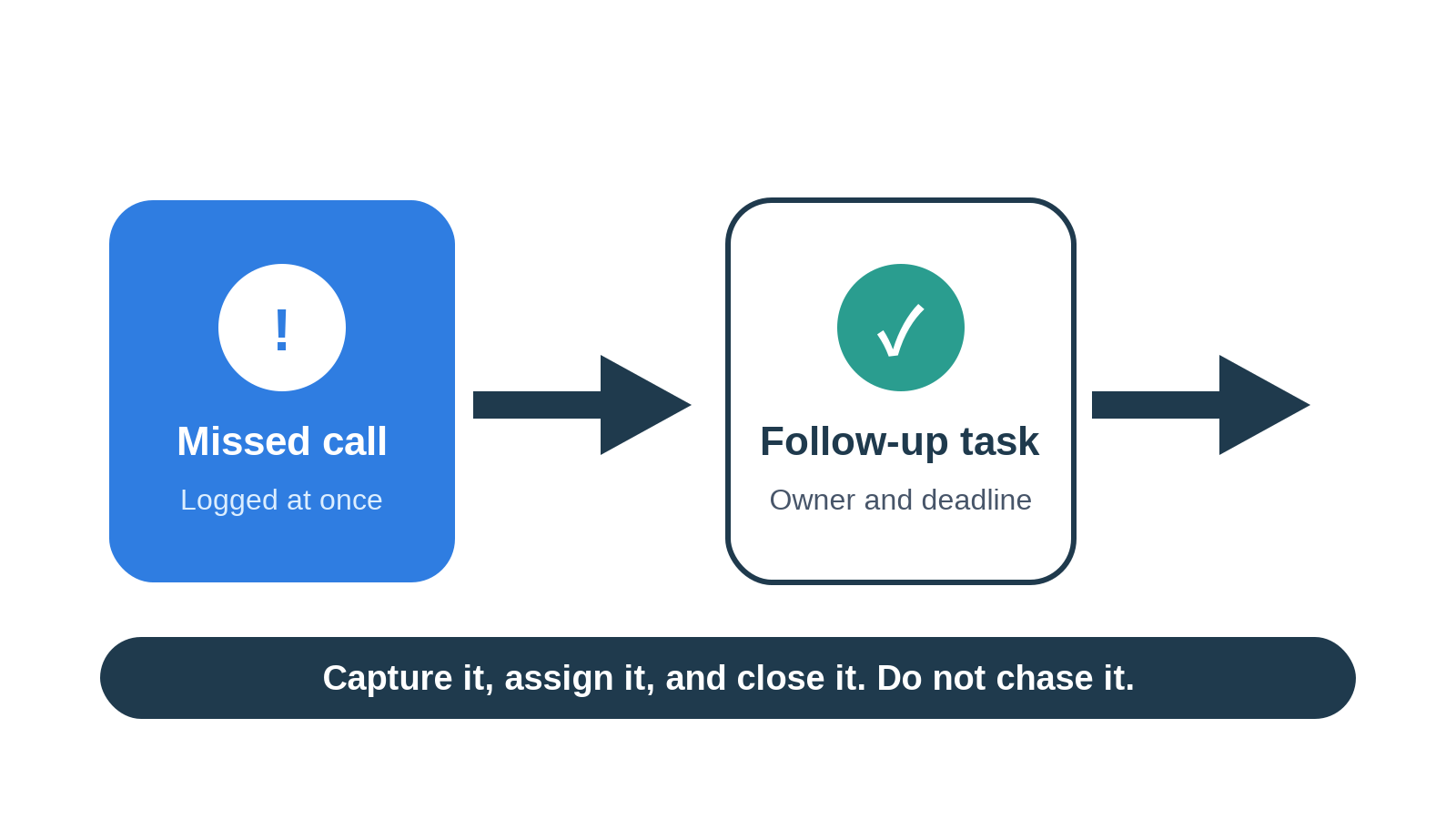
A missed call is not a lost customer yet. It becomes a lost enquiry when no one owns the callback, when the caller has to repeat the story, or when follow-up turns into repeated chasing that pushes the caller away.
The fix is a short, owned workflow: capture the enquiry once, assign it to one person with a deadline, make one useful first contact, and close the loop. This guide is for small service business owners and sales coordinators. It shows how to build missed call follow up automation that captures the enquiry without chasing, including consent and opt-out rules, an urgent branch, and clear stop conditions.
The direct answer is this: automation should create a task and a first message, not a campaign. People close enquiries. Automation makes sure no enquiry waits for someone to remember it.
What counts as a missed call worth following up
Start by defining the trigger. A missed call usually means a call that rang without an answer, a call that went to voicemail, or a call where the caller hung up before speaking to anyone.
Each type needs a slightly different first step. A voicemail gives you the caller's own words. A hang-up gives you only a number and a time, so the first message should ask for the need in one short question, not a long form.
Not every number needs chasing. Wrong numbers, spam calls, and callers who have asked to stop should be suppressed and logged, not added to a follow-up sequence. That suppression step matters as much as speed, because a follow-up sent to the wrong person damages trust and wastes staff time.
Capture the enquiry in one place
Every missed call should land in one list or customer system, with the same fields, whether it arrived during business hours or after hours. If missed calls live in separate inboxes, phone logs, and notebooks, no automation can fix the follow-up, because no one can see the full queue.
- Time and source. Record when the call arrived and whether it was a missed call, a voicemail, or a hang-up, so staff can judge urgency and context.
- Need in the caller's words. Keep the caller's own short description, and do not rewrite it into a sales category before a person has read it.
- Urgency and callback choice. Record whether the matter is urgent, routine, or unknown, and the caller's preferred callback number and time if they gave one.
- One record per enquiry. If the same person calls twice, update the same record instead of creating a second task that two people chase.
Keep the first capture short. Name, need, urgency, and callback preference are usually enough to route the enquiry. Detailed questions about budget, specifications, or account history belong on the callback, when the caller has chosen to talk.
Give every enquiry an owner and a deadline
An unowned task is a promise no one made. Assign each enquiry to one named person, with a named backup for absence, and a deadline that fits the urgency.
Urgent enquiries need a same-day owner and a faster first attempt. Routine enquiries need a next-business-day deadline that staff can actually meet. A deadline no one can meet is worse than no deadline, because it teaches the team to ignore the queue.
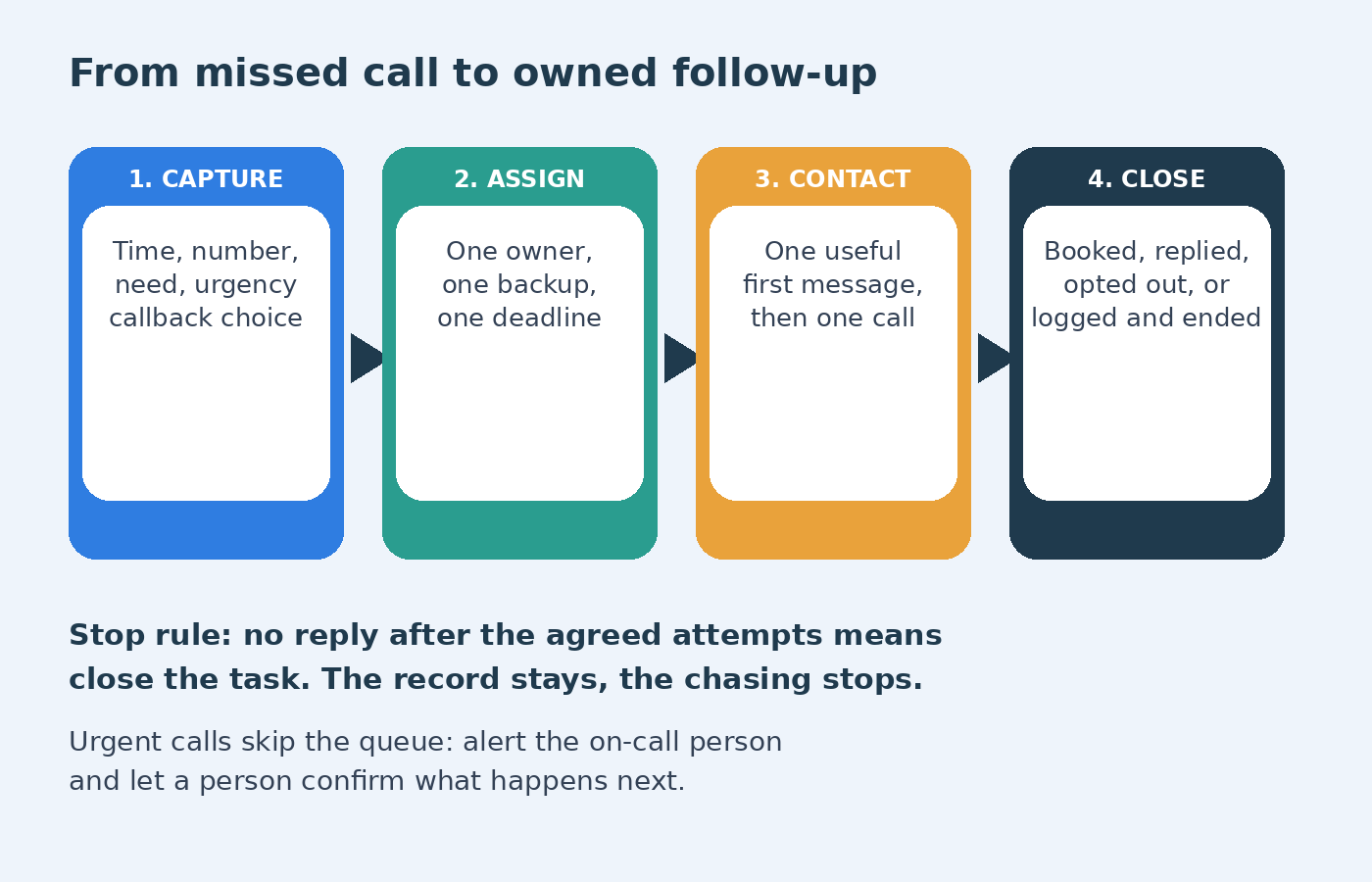
The missed-call workflow: capture the enquiry, assign one owner with a deadline, make one useful first contact, and close the task. Urgent calls skip the queue to the on-call person.
Make the queue visible. The owner, the deadline, and the last attempt should be visible to the team without opening five systems.
When a deadline passes, the task should escalate to the backup, not sit quietly. Review the queue at the start of each business day, and clear anything that was already answered by another channel, so staff do not call someone who already booked.
Send one useful first message, then stop chasing
The first message should do four things: name the business, say you missed the call, say what happens next, and offer one easy action. Keep it short and specific to the call, and do not promise a callback time you cannot staff.
A message sent after hours should give the next business day callback window, not imply someone is about to call at midnight. Consent and opt-out rules must be settled before any automated message goes out. A missed call is not, on its own, permission for ongoing marketing messages.
Keep the first message tied to the enquiry, include a simple opt-out such as replying STOP where your messaging system supports it, and honour opt-outs at once across channels. Consent, carrier, and jurisdiction rules vary, so have your approach checked before launch rather than treating this guide as legal advice.
Use a short, agreed cadence, and then stop. A practical starting rule for routine enquiries is one first message, one callback attempt, and one final message if there is still no reply, all inside business hours.
If the caller replies, the sequence stops and a person takes over. If there is no reply after the agreed attempts, close the task and keep the record.
Chasing beyond that point rarely recovers the enquiry, and it often costs the business goodwill. For the wider coverage question, including evenings and weekends, see our guide to after-hours call answering, which covers who owns each part of the day.
Handle urgent calls differently
Urgent calls must skip the routine queue. If a caller reports no heat, no water, a safety issue, or another urgent service problem, the workflow should alert the on-call person at once and require acknowledgement, with a backup if no one acknowledges.
The first message should confirm that the urgent request was received, ask for location and a brief description, and make clear that it does not confirm dispatch or arrival. Automation must never diagnose a hazard, promise an arrival time, or replace a person's judgement on an urgent job. For immediate danger, the caller should be directed to the local emergency service.
For urgent service matters, a person must assess the request and confirm what help is available. That boundary is the reason the urgent branch exists: speed to a person, not speed to a promise.
Close the missed-call loop honestly
Every enquiry needs an ending, even when the answer is no sale. Log the outcome in the same record: booked, called back and answered, replied and declined, wrong number, opted out, or no reply after the agreed attempts.
A closed task with a clear outcome helps the next review. An open task with no outcome helps no one.
Review the queue weekly by trigger and channel. Look for enquiries that waited too long, urgent calls that missed the on-call alert, messages that drew opt-outs, and first messages that callers misunderstood.
Fix one weak step at a time, and test the change on the next week's enquiries, rather than rebuilding the whole workflow on a hunch. If qualification matters once the caller responds, read our guide to AI lead qualification for service businesses, which explains what to ask before handoff and which fields staff need first.
Missed call follow up automation: a short launch checklist
- One queue. Every missed call lands in one visible list, with time, source, need, urgency, and callback choice.
- One owner per enquiry. Each task has a named owner, a backup, and a deadline that fits its urgency.
- Consent checked. The first message is tied to the enquiry, opt-outs are honoured at once, and the approach was checked before launch.
- Urgent branch tested. On-call alerts, acknowledgement, and backup were tested, and no automated message promises dispatch or arrival.
- Stop rule agreed. The team knows how many attempts a routine enquiry gets, and when to close the task.
- Weekly review set. Someone reviews outcomes by trigger and channel, and fixes one weak step at a time.
Frequently asked questions
Fast, but honest about timing. How quickly should the first message go out? As soon as your system can send a correct, staffed message, and inside the hours you can actually respond.
Speed helps, but a fast message that promises a callback you cannot make is worse than a slightly later message with a realistic window. No, agree the limit first. Should automation keep trying until the caller replies? No.
Agree the number of attempts in advance, stop when the caller replies, books, or opts out, and close the task after the agreed attempts with no reply. The record stays, so a later enquiry from the same person can be seen in context.
Skip the queue for urgent calls. What if the caller says the matter is urgent? Route it to the on-call person at once, ask for location and a brief description, and let a person confirm what happens next. Do not let the routine sequence, or an automated promise, delay that handoff.
A practical takeaway
Missed call follow up automation works when it is boring in the best sense: every call captured once, every enquiry owned by one person, one useful first contact, a clear urgent branch, and a stop rule the team actually follows. That discipline recovers enquiries without turning follow-up into chasing. If you want a custom workflow built around your phone system, CRM, and on-call rota, talk to DevxerTech AI services about a workflow that fits your team, not a generic sequence.

