
A caller rings a small service business and hears a greeting in a language they do not use well. They do not ask for a simpler option.
They hang up, or they guess at the answer, and the business never learns why the enquiry went quiet. It only helps if the conversation stays clear from the first greeting to the final booking or handoff.
This guide is for service business owners with customers in several languages. It shows how to design a multilingual AI receptionist that confirms language choice, keeps facts the same in every language, and hands off cleanly when it cannot help.
Short answer: design the conversation first. Then add languages one at a time, and test each one.
Start with the languages your customers actually use
Do not launch with every language a provider lists. Start with evidence from your own business.
Look at recent missed calls, website enquiries, and the languages your staff already use to help customers. Ask front desk staff which calls take longest, and which ones end without a booking because the caller and the business could not settle the details.
For many service businesses, two or three languages cover most enquiries. That smaller set is easier to test, easier to keep accurate, and easier for staff to support when a handoff arrives. Add another language only after the first set works in real calls, with reviewed transcripts and a named staff owner for escalations in that language.
- Count the demand. Use call notes, booking forms, and staff knowledge to rank languages by enquiry volume, not by assumption about the local population.
- Name the limit. Publish the supported languages in the greeting, so a caller in an unsupported language hears a helpful alternative at once instead of a long, confusing exchange.
- Match staff cover. If no one on your team can handle an escalation in a language, plan that handoff before launch, even if the plan is a callback from a named bilingual colleague.
Let the caller choose, then confirm the choice
There are two common ways to set the language. The receptionist can ask, in a short greeting, which language the caller prefers.
Or it can detect the language from the caller's first words and confirm it. Asking is slower but clearer.
Detection is smoother when it works, but it can misread short answers, accents, and callers who mix two languages in one sentence. Whichever route you choose, confirm the choice in the chosen language before taking details. A short confirmation such as repeating the language back and asking the caller to continue prevents a whole conversation in the wrong language.
If the caller switches language mid-call, the receptionist should follow the switch when it can, and say so plainly, rather than forcing the caller back to the first language. Record the preference for the next call only where your system allows it and your privacy approach supports it. A returning caller should not have to repeat a language choice every time, but a stored preference must never override what the caller says on the current call.
Keep the facts identical in every language
A multilingual receptionist fails quietly when answers drift between languages. Opening hours, service scope, booking rules, and prices must come from the same business information in every language.
If the English answer says a service is available on Saturdays and the translated answer omits that detail, the business has created two different offers. Have a fluent speaker review key answers in each language, especially anything about prices, policies, appointments, and safety.
Machine translation can produce a fluent sentence with the wrong meaning, and a fluent sentence is harder for a caller to question than a clumsy one. Keep names, phone numbers, addresses, and reference numbers unchanged across languages, and check regional wording with callers from the area you serve, since the same language can carry different everyday words in different places.
The following illustrative example shows why this matters. A clinic receptionist tells an English-speaking caller that a first visit needs 45 minutes, and tells a caller in another language that the visit takes about half an hour, because two different drafts were used.
Both callers were given a confident answer. Only one was given the right booking length. One approved source, reviewed in each language, prevents that kind of error.
Design the fallback before you launch
Understanding will fail sometimes. A caller may speak quietly, use an unfamiliar name for a service, or ask about something outside the receptionist's scope.
The design question is not whether that happens, but what the caller hears next. A good fallback is short, honest, and gives the caller a next step.
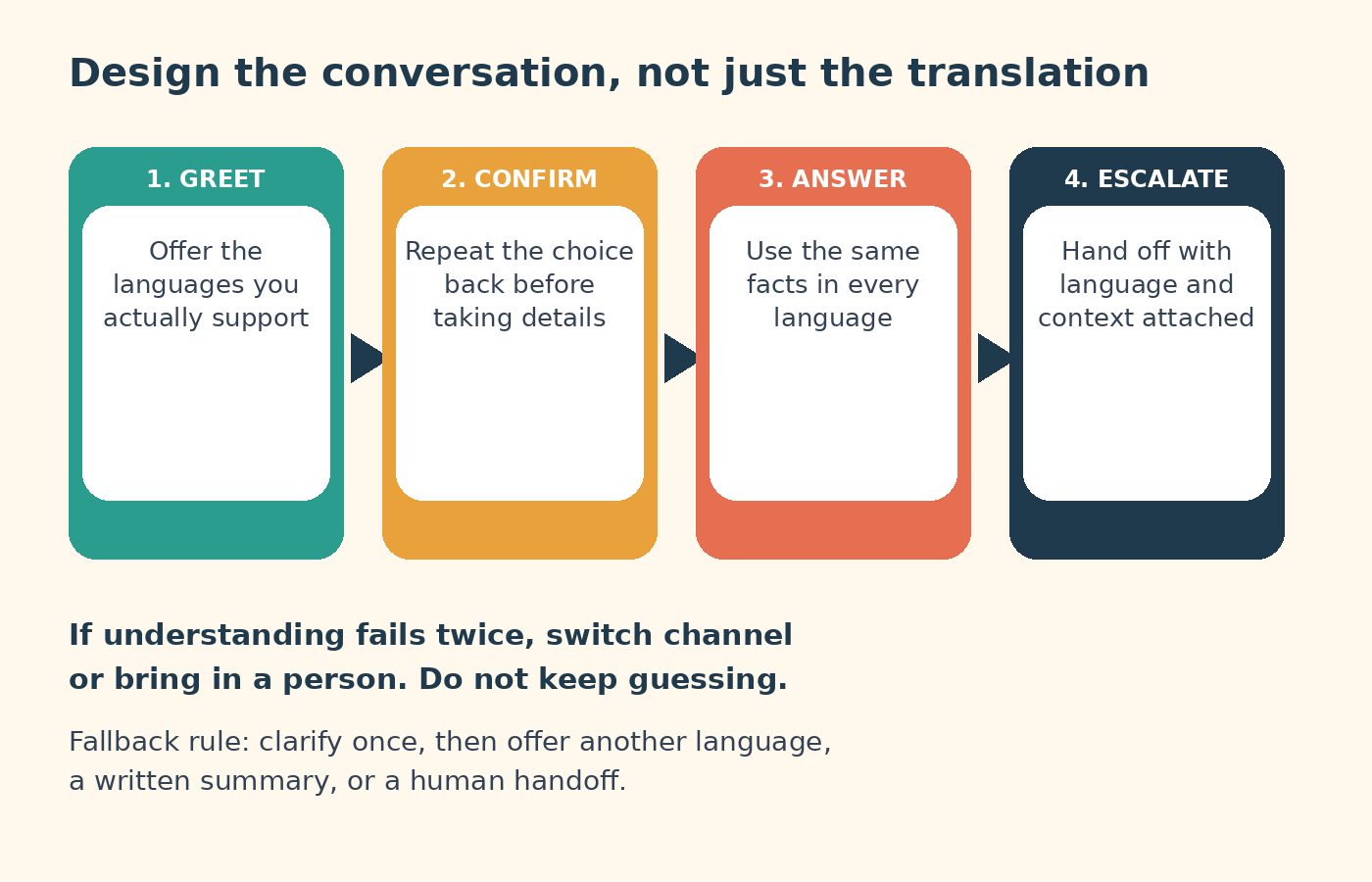
The conversation flow for a multilingual receptionist: greet in supported languages, confirm the choice, answer from the same facts, and escalate with context. If understanding fails twice, switch channel or bring in a person.
- Clarify once. Repeat back what was understood, in the caller's language, and ask for the missing detail in a different way.
- Offer another route. If clarification fails, offer another supported language, a written summary, or a callback, and let the caller choose.
- Bring in a person. After two failed attempts, or at once for an urgent, sensitive, or complex request, hand off to a person with the language and the conversation context attached. Do not keep guessing.
Route the handoff in the right language
A handoff in the wrong language undoes the work of a good multilingual conversation. When a caller needs a person, route the enquiry to a staff member who can continue in that language where possible, and attach a summary so the caller does not repeat everything.
Where a bilingual staff member is not available, say so, give a realistic callback time, and keep the original language note with the enquiry so the callback starts in the right place. Staff summaries need the same care as caller answers. Keep the original transcript or notes where your system stores them, and add a summary in the language your team works in, with the caller's language clearly labelled.
That way, a team member can act on the enquiry without misreading a translated detail, and the next person who speaks to the customer can see what was actually said. If booking on the call is the deciding factor, read our guide to AI appointment booking assistants, which explains availability checks, written confirmation, and the exception branch.
Test your multilingual AI receptionist with real callers in each language
Testing in one language does not prove the others work. For each supported language, run the same core test calls: a greeting and language choice, a routine booking, a question about hours or services, an exception such as no suitable slot, and an escalation to a person.
Add a mixed-language call and a call with background noise, since real calls are rarely clean. Listen to the recordings or read the transcripts with a fluent reviewer, and score each language separately.
Look for wrong facts, awkward confirmations, failed handoffs, and places where the receptionist answered confidently instead of asking for help. Fix the language that failed, then retest that language, rather than assuming a fix in one language carries over to the rest. For the wider coverage question, including evenings and weekends, see our guide to after-hours call answering, which covers who owns each part of the day.
A short launch checklist
- Supported languages named. The greeting lists only the languages you have tested and can support with staff handoffs.
- Facts checked per language. Hours, services, booking rules, and prices were reviewed by a fluent speaker in each language.
- Fallbacks rehearsed. Clarification, channel switch, and human handoff were tested, not just written down.
- Handoff owners named. Every language has a named person or callback plan, and summaries carry the caller's language.
- Review routine set. Someone reviews transcripts in each language in the first weeks, and fixes are tracked by language.
Frequently asked questions
Start small, and prove each language. How many languages should a small business launch with? Start with the two or three languages that cover most of your enquiries, test them properly, and add more only when staff handoffs and reviewed answers are ready for the next language.
Confirm the choice either way. Should the receptionist detect the language or ask the caller? Either approach can work. Asking is clearer, detection is smoother, and in both cases the receptionist should confirm the choice in the chosen language before taking details.
Be honest about the limit. What happens when a caller uses a language you do not support? Say so early, in a language the caller is likely to understand, and offer a clear alternative, such as a callback, a written enquiry, or a person who can help. Do not let the conversation continue on guesswork.
A practical takeaway
A clear multilingual AI receptionist is a set of decisions, not a language list: which languages you support, how the caller chooses, where the facts come from, what happens when understanding fails, and who takes over in the caller's language. Get those decisions right for a small set of languages, test them with real callers, and expand only when the evidence supports it.
For a receptionist-focused solution, explore Devxer Pros, Devxer Technologies' product offering for website chat, voice inquiries, and appointment workflows. If you want a custom build rather than a configured product, talk to DevxerTech AI services, and for customer conversations and lead qualification, see our chatbot development service.

